How fintech founders should evaluate a software development company.

Samuel Corso
Hiring
8
min read
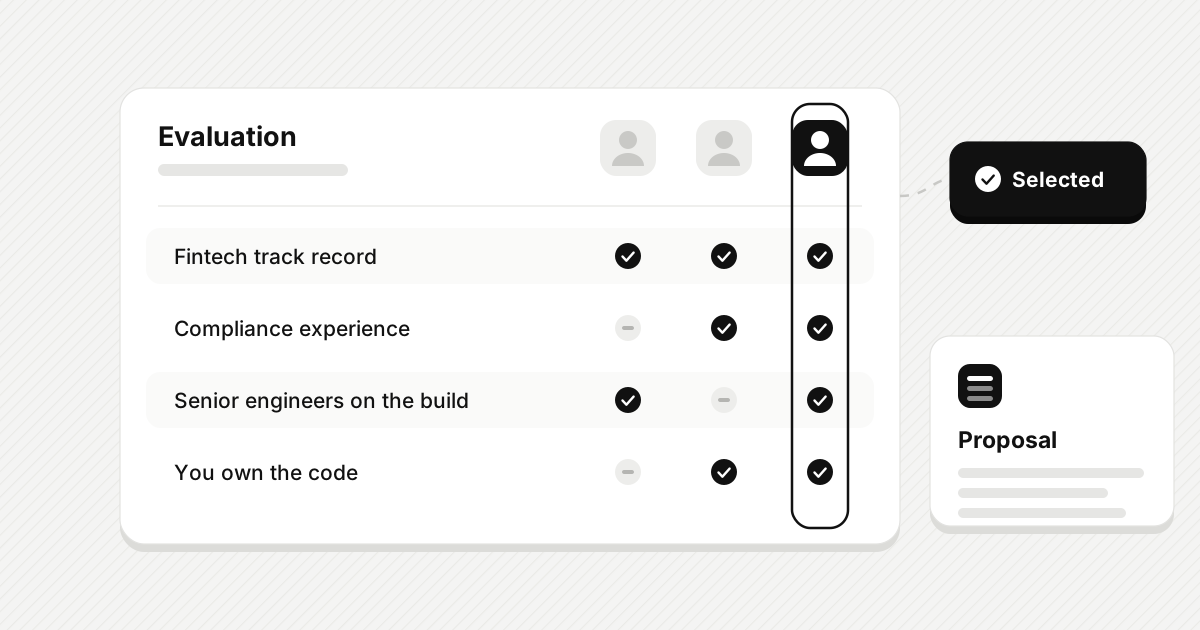
A fintech software development company is an outside firm you hire to design and build your financial product, usually because you don't have an in-house engineering team yet.
Some firms give you a full team: engineers, a designer, a project manager, and sometimes technical leadership. Others give you two contractors and an invoice.
This guide covers how to sort them, what to ask, and what a good answer sounds like.
What to define before you compare firms
Most founders take sales calls before they've settled what they're buying, and it puts them in a weak position. Every firm will shape your project into whatever they sell. Four things are worth pinning down first, so you're comparing like for like.
The first version you're building. A lending product with a waitlist and manual underwriting is a different build from a full loan origination system. The version worth scoping is the smallest one a real customer could use and pay for. One page is enough, and handing the same page to every firm is what makes their quotes comparable.
Who owns the technical decisions? With no CTO and no plan to hire one, you need a partner who will make architecture calls and tell you when you're wrong. With a technical co-founder already in place, you need capacity, and capacity costs less.
Your budget range and funding timeline. A precise number isn't necessary, but a band is, along with whether that band has to last you to a raise. A firm that knows you have nine months of runway scopes differently than one that assumes three years.
Your regulatory posture. Whether you're holding funds or a partner bank is holding them. Whether you're touching card data or a processor is. Legal answers can wait, but knowing which questions apply to you determines which firms are eligible.
Types of fintech software development companies
Almost every option falls into one of five categories, and they fail in different ways. Knowing which category you're talking to tells you what to probe.
Generalist offshore agencies. Large teams, low hourly rates, portfolios spanning e-commerce, healthcare, logistics, and fintech.
Best for: well-specified builds where you already have technical leadership reviewing the work.
Watch out for: fintech listed as one vertical among twelve, and engineers rotating off your project without notice.
Generalist product studios. Strong design, strong front end, usually onshore or nearshore, often very good at consumer apps.
Best for: products where the interface is the difficult part and money movement is thin.
Watch out for: ledger and reconciliation work they've never done, which surfaces after launch.
Fintech specialist boutiques. Small teams, narrow focus, higher rates, and usually a named technical principal you'll work with directly.
Best for: regulated builds where getting a ledger, reconciliation, compliance monitoring, and data security wrong is expensive.
Watch out for: limited capacity, which can push your start date out by weeks.
Marketplaces and staffing platforms. Toptal, Upwork, Gun.io, and similar. You're hiring individuals, not a team.
Best for: filling one specific gap, like a contract iOS developer, when someone on your side is directing the work.
Watch out for: no one owning the architecture, and no one accountable when two contractors build incompatible pieces.
Hiring in-house instead. Worth pricing as an alternative every time.
Best for: teams that have raised, know what they're building, and can wait out a hiring cycle.
Watch out for: a senior fintech engineer search regularly running three to five months, and a bad first engineering hire being harder to unwind than a bad vendor.
No category is universally correct. A pre-seed founder with a signed design partner and nine months of runway is looking for a different shape of firm than a Series A team adding capacity to an existing engineering group.
What makes fintech software development different
Ordinary software fails by showing the wrong thing. Financial software fails by moving the wrong amount to the wrong account, twice, and then reporting success. That difference is where generalist firms get exposed.
A firm that has built fintech before brings these up without being asked:
A real ledger. Money state belongs in a double-entry ledger with immutable entries, not in a balance column that gets updated. A firm planning to store balances as a number they increment hasn't built this before. Ask how they'd model a pending authorization that later settles for a different amount.
Idempotency. Payment APIs get called twice. Networks time out after the money has moved. Every write that touches funds needs an idempotency key so a retry doesn't double-charge someone. This is table stakes and it's regularly missing.
Reconciliation. Your system's view and your bank or processor's view will drift. You need an automated daily process comparing them and flagging breaks, built from the start. Retrofitting reconciliation after launch is painful, and it's how founders discover six weeks of quiet discrepancies.
KYC, CIP, and sanctions screening. Identity verification at onboarding, ongoing screening against OFAC and other watchlists, and a documented way to review decisions. Our guide to KYC providers for fintech startups covers the vendor side.
PCI DSS, if card data touches your systems. The current standard is PCI DSS 4.0.1. Most early fintechs should architect to stay out of scope entirely by tokenizing through a processor rather than handling card numbers, and a good partner pushes you toward the smaller scope.
Sponsor bank and BaaS constraints. Going through a provider like Unit, Increase, Column, Lithic, or Treasury Prime means their rules shape your product. Payout timing, dispute handling under Reg E, account limits, and what you're allowed to say in your marketing all come from that relationship. The Synapse collapse in 2024 is why experienced teams now ask hard questions about where funds sit.
Audit trails and data handling. Who did what, when, and why, stored immutably. You'll need it for disputes, for your eventual SOC 2, and for your first partner bank diligence review.
For the deeper regulatory picture, what fintech compliance means goes further than we can here.
How to evaluate a fintech software development company
With three or four firms shortlisted, the same five steps run on each one produce answers you can line up side by side.
Ask for a fintech build they shipped, then ask what broke. Any firm can show a portfolio. Ask about a specific financial product they launched, then ask what went wrong after launch and how they handled it. Teams who have done this have a reconciliation story or an incident story, and they tell it plainly. Teams who haven't keep the answer abstract.
Find out who writes the code. Names and locations of the people on your project, whether they're employees or subcontractors, and what else they're staffed on. Sales engineers who appear on the pitch call and never again is the most common complaint founders have about agencies.
Ask the ledger question. "How would you model the balance in this product?" You're not grading the architecture. You're checking whether they reach for double-entry and immutability on instinct. This question separates fintech firms from general firms faster than anything else on the call.
Get IP ownership and handoff in writing. You should own the code, the repositories, the cloud accounts, and the domain from day one, not on final payment. Ask what happens at the end: documentation, a runbook, credential transfer, and a window where they're available to answer questions from whoever takes over. A firm with no handoff process is counting on you never leaving.
Call a reference they didn't hand you. Ask for three past clients, then find a fourth yourself through LinkedIn or their case studies. Ask that fourth client one question. Would you hire them again for the same work?
Questions to ask on the first call
These answers tell you more than the deck will.
Who specifically will be on this project, and are they employees or subcontractors?
What's your experience with sponsor banks or BaaS providers, and which ones?
How do you handle reconciliation between our system and the processor?
What happens if we need to change scope in week six?
Who owns the IP, and when does ownership transfer?
What does your handoff look like if we bring engineering in-house next year?
What have you declined to build, and why?
That last question is the most useful one on the list. A firm that has never turned down a project is selling capacity, not judgment.
Red flags when hiring a fintech development company
Some of these are dealbreakers on their own. The rest earn a direct follow-up question.
A fixed quote with no discovery. A real fixed price takes a week or two of scoping. A number on the first call means a padded estimate or a change order waiting to happen.
No named technical lead. If you can't identify the person accountable for architecture, there isn't one.
Vague fintech claims. "We've worked with fintech clients" is not "we built the ledger for a neobank." Push until you get a specific product.
Code ownership on final payment. This is leverage, and it's the wrong kind.
No questions about your regulatory setup. A firm that doesn't ask who holds the funds will build you something that assumes an answer.
Resistance to a paid pilot. Most good firms will do a small, scoped, paid first phase. Refusal usually means they need the full contract for the economics to work.
Fintech software development pricing models and costs
Pricing models matter more than headline rates, because the model decides who absorbs the risk when scope moves.
Fixed price, fixed scope. A defined build for a set fee.
Best for: first MVPs where budget certainty matters.
Watch out for: anything outside the written scope becoming a change order, which makes the scope document the real contract.
Time and materials. You pay for hours worked.
Best for: ongoing work where priorities shift week to week.
Watch out for: no ceiling, so a burn cap and weekly visibility are necessary.
Staff augmentation. Monthly cost for named engineers embedded in your team.
Best for: teams with a CTO who need capacity.
Watch out for: you're providing direction, so it only works with someone on your side leading.
Fractional technical leadership. Senior technical direction a few days a month, sometimes bundled with a build.
Best for: non-technical founders with no CTO. We broke this down in fractional CTO vs full-time CTO.
Story point budgets. A hybrid of the two above. You agree on a total budget of story points, a fixed number of points per sprint, and a fixed price per point.
Best for: builds that need a cost ceiling when the scope is going to move.
Watch out for: the point estimates are the firm's, so ask to see how they size a handful of items before you sign.
For a fintech MVP built by a specialist firm in the US or Western Europe, fixed-price engagements commonly land between $45,000 and $150,000, depending on the nature of the product. Offshore generalists quote well under that. The gap is real, and so is the cost of rebuilding a ledger. What it costs to build a fintech app breaks the line items down.
One note on budget. A working prototype you built yourself with AI tools isn't always something a firm can extend, so it's worth asking them to review it first. We've written about the risks that come with vibe-coded products, and the short version is that a two-week paid review costs far less than discovering the problems in month four.
How TechSuite works
TechSuite is a fintech software development firm, so we're one of the options in the specialist category above. Here's how we work, so you can weigh us against the rest of your list.
We're a NYC-metro team led by founder and CEO Sam Corso, with more than ten years of fintech engineering behind the practice and 30+ clients shipped. Our focus is technical leadership for fintech startups, which covers digital banking, lending, personal finance, insurtech, blockchain and crypto, and capital markets.
There are three ways to work with us:
Build your product. Idea to launch, with senior technical leadership making the architecture and vendor decisions a CTO would make if you had one. This fits founders with no in-house engineering team who need a first version in market.
Extend your team. Teams of two to six developers with a dedicated delivery manager, scaling up and down sprint by sprint without the HR overhead. This fits teams that already have a CTO and need fintech depth or more capacity.
Audit and optimize. A review of an existing product, which is where most founders start when they've built something quickly and want a second set of eyes before real money runs through it.
We price on a story point budget: a fixed number of points per sprint at a fixed price per point, against a total budget agreed up front. You get the cost ceiling of a fixed bid with the freedom to change what those points build, sprint by sprint.
The engineering is full-stack web, mobile, AI, and blockchain work in the TypeScript/JavaScript and Ethereum ecosystems, plus the integration layers behind fintech platforms: Plaid, Stripe, BaaS platforms, KYC/AML vendors, and more.
Engagements start with a discovery call, then one to two weeks of scoping and team assembly, then a sprint kickoff. You get Slack access and weekly demos the whole way through, and we reply within 12 hours. We're currently booking projects for late 2026 and 2027.
We also turn work down. If your build has no real money movement in the first version, a strong generalist studio will serve you better and cost less, and we'll say so on the call.
Fintech software development FAQs
How much does a fintech software development company cost? Fixed-price MVP engagements with specialist firms typically run $45,000 to $150,000. Staff augmentation is priced per engineer per month. Offshore generalist agencies quote significantly lower, with more variance in outcome.
How long does a fintech MVP take to build? Three to six months is the normal range for a first version with real money movement. Products that stay out of PCI scope and use a BaaS provider for banking infrastructure move faster.
Should I hire an agency or a full-time engineer first? Pre-product and non-technical founders get to a working product faster with a firm, because you're buying a whole team instead of betting the company on one hire. Once you have customers and a roadmap, in-house usually wins on cost.
Do I need a fintech specialist, or will a general agency do? It depends on how much money movement is in your first version. If a partner holds the funds and you're building an interface on top, a strong generalist can do it. If you're designing a ledger, handling disputes, or building payment flows, specialist experience saves you a rebuild.
Who should own the code? You, from the first commit. Get it in the contract, along with ownership of the repositories and cloud accounts.
Choosing your fintech development partner
Start with the one-page scope. From there, two firms from different categories, one specialist and one generalist, will show you the most, because the difference in how they respond to the same document tells you more than either deck. Run both through the five evaluation steps, ask every question on the call list, and buy the smallest paid engagement either one offers before signing anything large.
Two paid weeks teach you more about a firm than two months of sales calls.
If you want a second opinion on a quote you've received or a codebase you've already started, book a call with Sam and we'll tell you what we see.
Related reading


